
菜单
关闭




|



Heavy Fuel Oil (HFO), also known as Residual Fuels, refers to the residual heavy oil after extracting light hydrocarbon products such as gasoline and diesel from crude oil. The density (g/cm ³) of heavy oil is generally from 0.82 to 0.95, and the calorific value is around 10000 to 11000 kcal/kg. The boiling point range is between 300 ℃ and 700 ℃. The characteristics of heavy oil are high molecular weight and high viscosity. Due to its semi-fluid consistence, HFO has to be preheated to make it combustible in engines.
Classification of Residual Fuels (HFO):
1. Classification based on whether Residual fuels (HFO) contains biofuels:
1.1. Residual Marine Fuels (RM), refer to the high viscosity, tar like substances that remain after distillation and cracking of crude oil in order to produce light hydrocarbon products (such as gasoline, diesel, and heating oil or feedstocks for lubricants). The main components of RM fuel are alkanes, cycloalkanes, and different hydrocarbons, which belong to traditional petroleum based residue fuels. For Stationary power plants, heavy fuel oil mostly refers to RM fuels. Classify according to viscosity and sulfur content, such as RME180, RMG380, RMK700, etc. For detailed specifications of HFO, please refer to: HFO Specification.
1.2. Bio Residual Fuels (RF), refers to residual fuels containing biofuels. Unlike traditional RM fuel, which mainly comes from petroleum, RF fuel allows for the mixing or complete use of biodiesel (i.e. FAME) made from animal and vegetable fats to support the low-carbon transformation of the shipping industry. Suitable for power plants or ships pursuing emission reduction. The coding rules are the same as RM fuel, such as RF380-0.5, RF500-0.1, etc.
2. Classification based on the sulphur content in Residual fuels:
I. High Sulfur Fuel Oil (HSFO): Sulphur content > 0.50% (m/m), with sulphur content reaching 3.50% (m/m) or even 4.50% (m/m) or above. Suitable for use in non emission control areas of power plants without desulfurization devices. The HFO used in Stationary power plants is mostly HSFO.
II. Very Low Sulphur Fuel Oil (LSFO or VLSFO): Sulphur content ≤ 0.50% (m/m).
III. Ultra Low Sulphur Fuel Oil (ULSFO): Sulphur content ≤ 0.10% (m/m).
The international trade names for HFO are RM (RMA, RMB, RMD, RME, RMG, RMK) and RF. They are mainly named based on the quality of the heavy fuel oil (such as viscosity, sulphur content, etc.) and whether it contains FAME. These names correspond to heavy fuel oil products of different qualities and specifications, and should be distinguished according to specific purposes and standards in practical applications.
Cheap, but challenging.
As a residual product, HFO is a relatively inexpensive fuel – it typically costs 30% less than distillate fuels (MDO/MGO). It thus became the standard fuel for large marine diesel engines during the oil crisis in the 1970s and 1980s, and it required extensive adaptation of the injection system and other components of low and medium speed engines – which are still the only reciprocating engines capable of running on HFO.
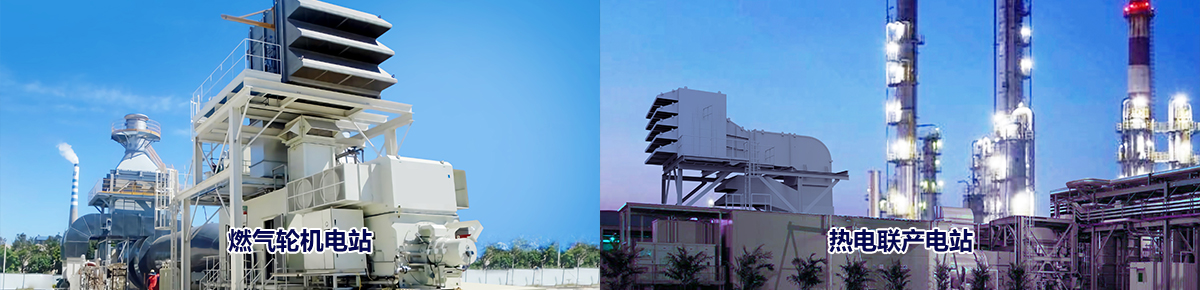
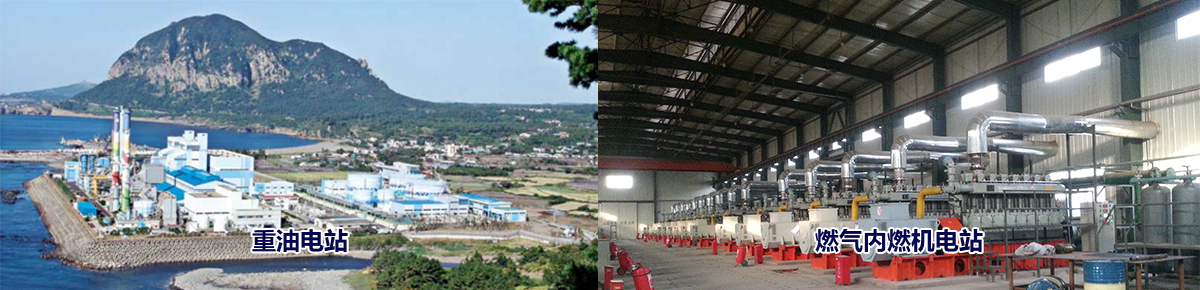
Most of our medium speed liquid fuel engines can burn heavy fuel oil (HFO). Of course, our medium speed dual fuel engines are capable of burning HFO in liquid fuel mode as well.
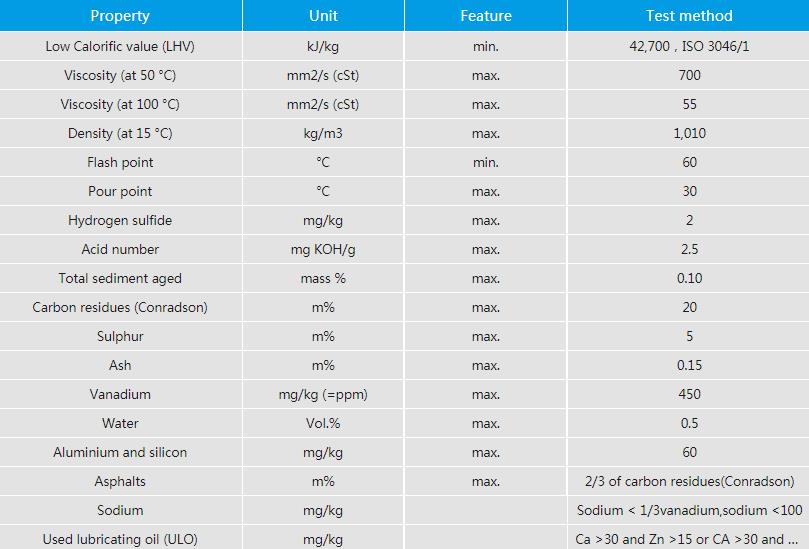
Must prior to heavy fuel oil handling (storage, settling, centrifuging, filtration, and heating) before engine use. In summary, the suitability of fuel depends on the design of the engine and the available cleaning options, as well as compliance with the properties in the following table that refer to the as-delivered condition of the fuel.
Remarks:
1) Engine inlet requirement: Additional parameters defined for ISO 8217. The entire ISO 8217:2024 document is mandatory. The fuel mixture at the engine inlet must be homogeneous. The fuel mixture is homogeneous if the p-value according to ASTM D7060 is at min. 1.20. Other processes (e.g. ASTM D7112 or ASTM D7157) can also be used to check the homogeneity of the fuel mixture. Furthermore, the fuel must be fit for use and must not contain substances in a concentration that contributes to further contamination of the air and/or may impair the safety of personnel or the performance of the machine.
2) Always reference the latest edition.
3) If FAME is present in the HFO (RF), the max. viscosity is limited to 500 mm²/s at 50°C. Specific requirements of the injection system must be taken into account.
4) SOLAS provision: A lower flash point is possible for non-SOLAS-regulated applications.
5) The pour point must be selected by the operating company in accordance with the design of the fuel system and based on the requirements at the place of installation.
6) When using RF (FAME according to EN 14214 or ASTM D6751* or their mixtures with HFO), prior consultation with Soar is required. The FAME must either be in accordance with EN 14214 or with ASTM D6751 as well as with increased oxidation stability of at least 8 hours (EN 15751).
7) Independent of the maximum permissible sulphur content, local laws and regulations must be adhered to.
8) According to ISO 8217:2024, the bunker product (before purification) may contain max. 0.50% water.
9) The bunker product (before cleaning) may contain max. 60 mg/kg Al and Si.
Notes:
1. All data provided on this site is for information purposes only, explicitly non-binding and subject to changes without further notice.
2. To confirm whether the engine can use special types of fuel, please provide detailed fuel specifications.